
2025 Annual Review Meeting
Recap
The Research and Development Division of the Ghana Health Service held its 2025 Annual Performance Review Meeting under the theme “Leveraging Health Research to Inform the Implementation of Free Primary Health Care Policy in Ghana.”
The event took place on Thursday, 12th March, 2026 at the Greater Accra Regional House of Chiefs in Dodowa within the Shai-Osudoku District, bringing together health professionals and stakeholders to assess progress and strengthen the role of research in healthcare delivery.
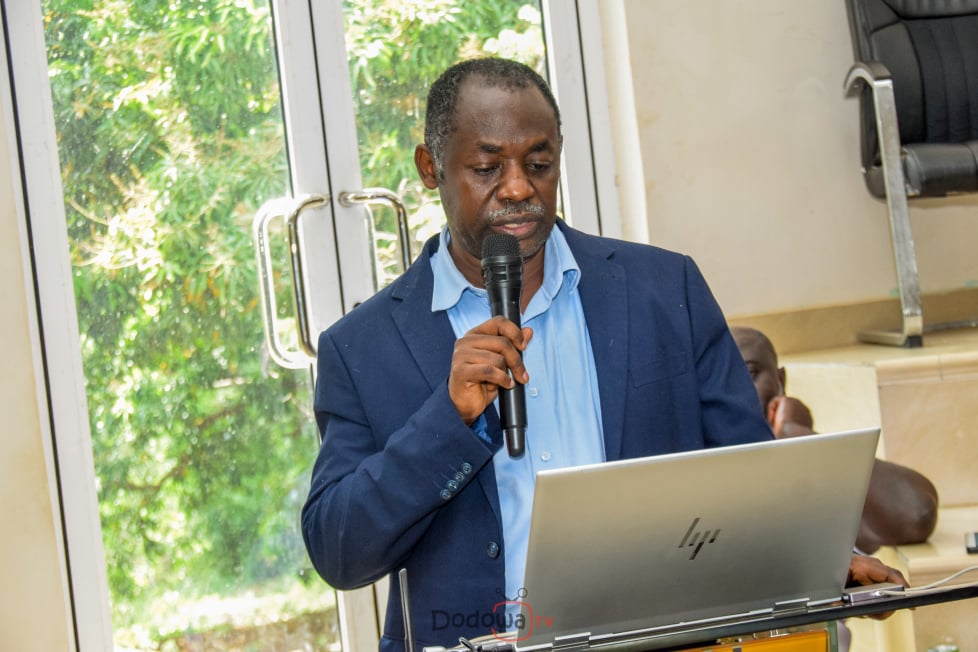
The meeting commenced with opening remarks from the Chairperson DR. Abraham Oduro (Director-Research and Development Division), who welcomed participants and emphasized the importance of the annual divisional review meeting. The Chairperson highlighted that the meeting serves as a platform for the division to reflect on its activities over the past year, assess achievements and challenges, and collectively set strategic objectives for the coming year. Participants were encouraged to actively contribute to the discussions as each department would present their performance and proposed objectives.
The Chairperson also pointed out some of the routine activities of the division, which are still very important to its mandate. The routine activities are mainly categorized under three main aspects: research coordination and conducting research, ethics review and approvals, and documentation and dissemination of research outputs.
The division is still very instrumental in coordinating research activities within the centre's. This also includes ensuring that high-quality research is conducted within the institution. This is done by overseeing research protocols conducted within the institution to ensure that they are conducted to the expected standards.
After the chairman's comments there were presentations from the Directors of the Kintampo, Navrongo, and Dodowa Health Research Centres. The session highlighted the Centres’ 2025 achievements, ongoing projects, capacity building, and strategic priorities for 2026, emphasizing their contribution to evidence-based policy and health system strengthening in Ghana. All three (3) reported on the declining in research funding, staff retention, and high operational costs.
The Director of RDD also drew attention to the recent Memorandum of Understanding (MOU) between Dodowa Health Research Centre and the University of Ghana, noting its potential to serve as a model for national policy whereby all three research centres could affiliate with established universities. Such affiliations, he suggested, would allow qualified researchers to hold faculty positions, fostering career growth and attracting young talent to the research centres.
Dr. Teddy emphasized the need to establish a credible platform that could be used to disseminate research outputs. She observed that the current focus of the journal initiative is based on the Ghana Health Service. She, however, pointed out that there might be some benefits in considering the scope of the initiative. She explained that the initiative might potentially be developed into a “Ghana Health Service Journal.” She added that this would allow the initiative to attract high-quality research papers not only from Ghana but from the rest of the world focusing on Ghana Health Issues.
Additionally, she advised that the editorial structure of the journal should be enhanced to include thematic editorial areas. This would enable the manuscripts to be efficiently allocated to the editor with the relevant expertise in the relevant thematic area. She also stressed the need to expand the pool of the reviewers and utilize the network of professionals who had previously been trained or worked with the research centers. Involving this group as associate reviewers or junior editorial members may assist in improving the review process while at the same time promoting professional collaboration.
Dr. Teddy also encouraged the research centers to take advantage of their existing associations with academic institutions and researchers. While academic reviewing may not be a lucrative activity, she stressed that it is an important activity that should be encouraged as it enhances the research community.
Strategic Priorities for 2026
• Align research with Ghana's flagship initiatives: Free Primary Health Care, MahamaCares, and 24-hour health services
• Conduct baseline and implementation research on Free Primary Healthcare
• Expand research centres to other regions
• Develop the GHS Journal as a leading national and global research platform
• Explore university affiliations (UG, KNUST, UDS) to attract and retain researchers
Major Challenges
• Declining donor funding and high operational costs
• Staff retention difficulties
• Inadequate documentation of research activities
Key Recommendations
• Conduct a scoping review of existing government health programmes to inform policy
• Leverage Health and Demographic Surveillance Systems (HDSS) for cost-effective data collection
• Establish two committees — one for scoping reviews, one for developing data collection tools
• Accredit laboratory services under the National Health Insurance to generate revenue
Despite resource constraints, the division demonstrated strong research output and innovation. Strategic collaboration, university partnerships, and focused research on government health initiatives will drive impact in 2026 and beyond.
Next Steps of Action:
• Continue ongoing studies and submit remaining reports.
• Implement the RDD 2026 strategic plan, with focus on research coordination, ethics management, dissemination, and advocacy.
• Strengthen collaboration platforms with universities and operational divisions
The meeting reaffirmed the commitment of stakeholders to leveraging research to support the successful implementation of free primary health care in Ghana.




Connect with Us